
Advantages
- Precise and advanced surgical technique to recreate the shape and projection of the areola and nipple
- Most procedures avoid the need for a skin graft or harvesting tissue from the opposite nipple
- This is the final step in breast reconstruction, offering closure and a return to body harmony after breast cancer
General Overview
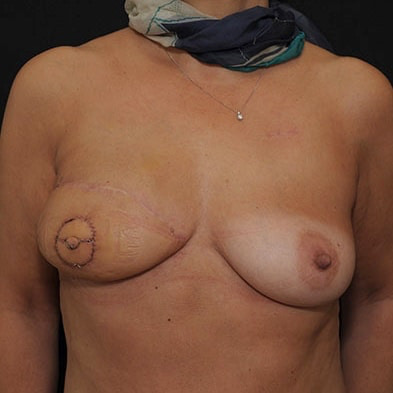
Areola and nipple reconstruction is a key milestone in the overall breast reconstruction journey. This final phase enhances the natural appearance of the reconstructed breast and contributes significantly to a sense of physical and emotional completeness.
In the majority of cases, we use the skate-flap technique, which enables us to restore the form, volume, and projection of the areola and nipple without grafting from distant body sites.
The Skate-Flap Technique
This method involves:
- Drawing two semicircles (half-areolas) on the breast, one of which includes the area for the future nipple
- Folding and suturing these sections toward the center
- Closing the peripheral area with a “round-block” suture to create a unified areola
- Final aesthetic touch: medical tattooing, performed one month later, to recreate the areola’s natural pigmentation
Alternative Techniques
In some cases, the skate-flap is not suitable—typically when the breast skin is too thin. In such cases, we may:
- Use a skin graft from the root of the thigh (a more invasive option with potential for visible scarring or unwanted hair growth)
- Graft half of the healthy nipple from the opposite breast if there’s a significant size difference between nipples
Surgical Procedure
- Performed as an outpatient surgery
- Carried out under either local anesthesia with sedation (neuroleptanalgesia) or general anesthesia
- Pre-anesthesia consultation required at least 48 hours prior
Areola tattooing can be done in-office under local anesthesia, or in the operating room if combined with other procedures.
The skate-flap technique is painless and requires only minimal postoperative care. No sick leave is typically required.
In contrast, skin graft procedures are more painful and usually require 5 to 7 days off work.
Our Approach
We have been using the skate-flap technique exclusively for the past four years due to its excellent results. It has significantly reduced the disadvantages previously seen with skin grafts, such as:
- Visible or uncomfortable scars at the thigh donor site
- Hair growth on the areola requires electrolysis
We reserve alternative techniques for rare, complex cases.
Questions / Answers
When can areola and nipple reconstruction be performed?
Generally, 1 month after breast volume reconstruction. However, if a breast reduction or lift is planned on the other side, it’s better to wait 2–3 months for the final areola position to stabilize.
What is postoperative care like?
- Gentle disinfection of the scar
- Protective compress with a hole in the center to avoid pressure on the new nipple
- Application of Mepilex Border Flex dressing for 2 days to allow for showering
Can this be combined with other procedures?
Yes. Areola and nipple reconstruction is often performed alongside symmetrization procedures (e.g., reduction or lift of the contralateral breast), or with lipofilling (fat grafting) to refine the upper breast contour or cleavage.
How much does it cost?
- The procedure is covered by French health insurance
- However, additional fees apply, ranging from €800 to €1,200, depending on the technique
- Tattooing costs €500 per session, with 1 to 2 sessions typically required
Before & After Results
Dr. Benjoar and Dr. Berdah have performed areola and nipple reconstructions for over 20 years.
You can view a gallery of before-and-after photos showcasing their natural, discreet results.