

Plastic surgeons play a central role in the treatment of skin cancer. Their expertise in both anatomy and aesthetics ensures they can address the two main goals of facial reconstruction:
- Complete removal of the tumor
- Achieving the most discreet aesthetic result possible
Principles
The type of skin tumor is diagnosed by your dermatologist through a clinical examination and biopsy. These tumors fall into two main categories:
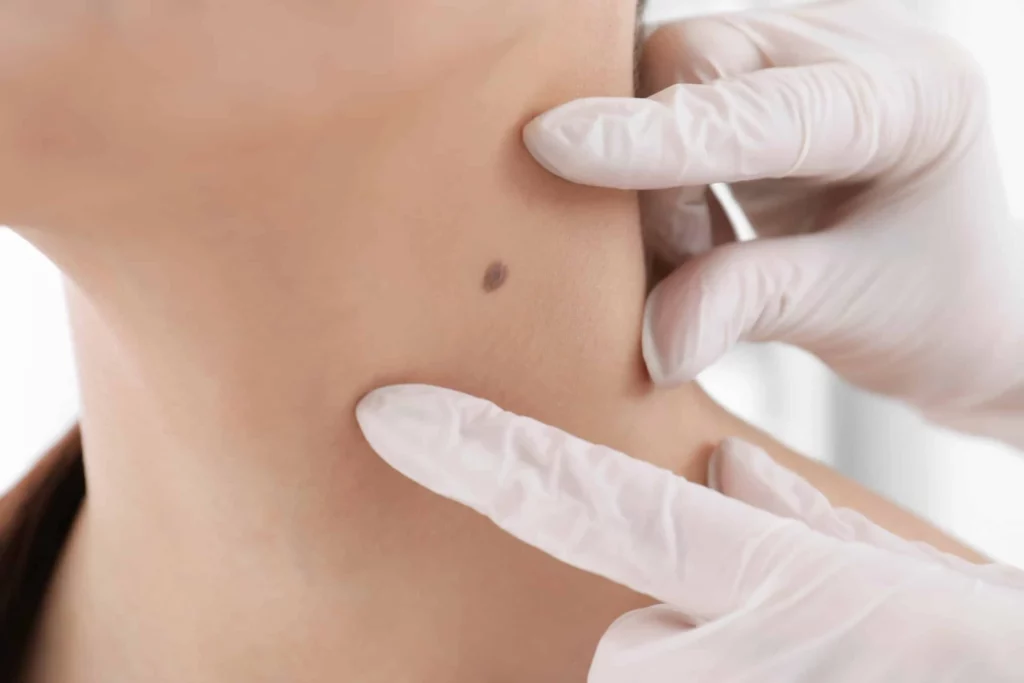
- Benign tumors: such as nevi (moles), histiocytofibromas, hamartomas.
- Malignant tumors: including basal cell carcinoma, squamous cell carcinoma, and malignant melanoma.
Surgical excision follows strict guidelines established by the French National Cancer Institute. For certain cases—especially squamous cell carcinoma or melanoma—a multidisciplinary consultation meeting (RCP) is required before proceeding with treatment.
Our team collaborates with the tumor board of Saint Louis Hospital (Paris) to ensure coordinated, state-of-the-art care.
To achieve the best possible aesthetic outcome, various reconstructive surgical techniques may be used to replace the skin removed during tumor excision:
- Directed healing: Letting the wound heal naturally; often ideal for small facial lesions (nose, forehead).
- Direct closure: Suturing the wound along the skin’s natural tension lines.
- Skin grafting: Skin is harvested from a donor area with similar tone and texture and placed over the excised area.
- Local flap: Adjacent skin is rotated or moved into the defect, maintaining aesthetic harmony.
- Regional flap: For instance, forehead skin is rotated to rebuild part of the nose.
- Free flap: Skin from a distant site (e.g. forearm) is transplanted with its own blood vessels and reconnected microsurgically near the defect—reserved for large or advanced tumors, particularly those invading bone.
In Practice
- A pre-operative consultation with your dermatologist is almost always required.
- If necessary, your case is presented at a multidisciplinary tumor board (RCP).
- Most procedures are performed under local anesthesia with sedation (neuroleptanalgesia), on an outpatient basis (3 to 5 hours).
- In some cases, a short overnight hospital stay may be recommended.
- A consultation with the anesthesiologist is required at least 48 hours before surgery.
Important precautions:
- Stop smoking at least one month before and after the procedure, as it can delay healing.
- Avoid aspirin and anti-inflammatory medications in the 10 days prior to surgery.
Healing and recovery:
- Final wound healing typically occurs within 10 to 15 days, at which point sutures are removed.
- The surgical specimen is analyzed and your surgeon will discuss results and post-operative care with your dermatologist.
- Further treatments such as radiation therapy may be required depending on the tumor type and margins.
Please note: Final aesthetic results can only be evaluated at least 6 months post-surgery.